Cross chain communications using Chainlink CCIP
Introduction to cross chain communications and Chainlink CCIP. We will cover the basics of Chainlink CCIP and how it enables cross chain communications.
Originally published on Septem6, 2024 on my previous blog.
The blockchain world is booming, and with it comes the rise of multiple blockchains, each serving different needs. But here’s the catch—most of these blockchains can’t communicate with each other easily. This is where cross-chain interoperability steps in. To address this issue, various protocols like Chainlink’s Cross-Chain Interoperability Protocol (CCIP), Polkadot, and Cosmos are working to solve this problem.
In this post, we’ll focus on the basics of Chainlink CCIP, how it works, and where it fits into the broader push for cross-chain communication.
What is Chainlink CCIP?
At its core, Chainlink CCIP is a protocol that allows different blockchains to communicate by transferring data and value between them securely. Think of it as a universal translator that helps smart contracts on one blockchain talk to those on another.
Key Features of CCIP
- Cross-Chain Data Transfers If you need to pull data from one blockchain into another, CCIP makes it happen with less fuss. It’s especially helpful for DeFi apps that might want to make a cross chain contract call or access key data across chains.
- Universal Messaging CCIP provides a common language for blockchains to communicate, making it easier for developers to connect different networks without reinventing the wheel every time.
- Secure and Decentralized Chainlink’s decentralized oracle network (DON) secures cross-chain communication. This makes it tough for bad actors to mess with the messages or transactions being sent across chains.
- Token Transfers Need to move tokens or assets across chains? CCIP simplifies that process, whether it’s for NFTs, stablecoins, or other crypto assets.
How Does CCIP Works?
CCIP connects different blockchains via lanes. CCIP lanes are a unique combination of source and destination chains. This lane are unidirectional but most of the time, there are two lanes for each pair of chains to make the communication bidirectional.
Chainlink configures a router contract on each participating blockchain to manage the lanes. The router contract in source chain communicates with the Chainlink DON which then sends the data to destination chain's router contract.
We all know that each blockchain has a chain ID but Chainlink uses a chain selector to identify the chains. The chain selector is used when selecting the destination chain in a cross chain transaction. To have a chain selector, the chain must be registered with Chainlink CCIP.
Here is the basic architecture of CCIP Source:
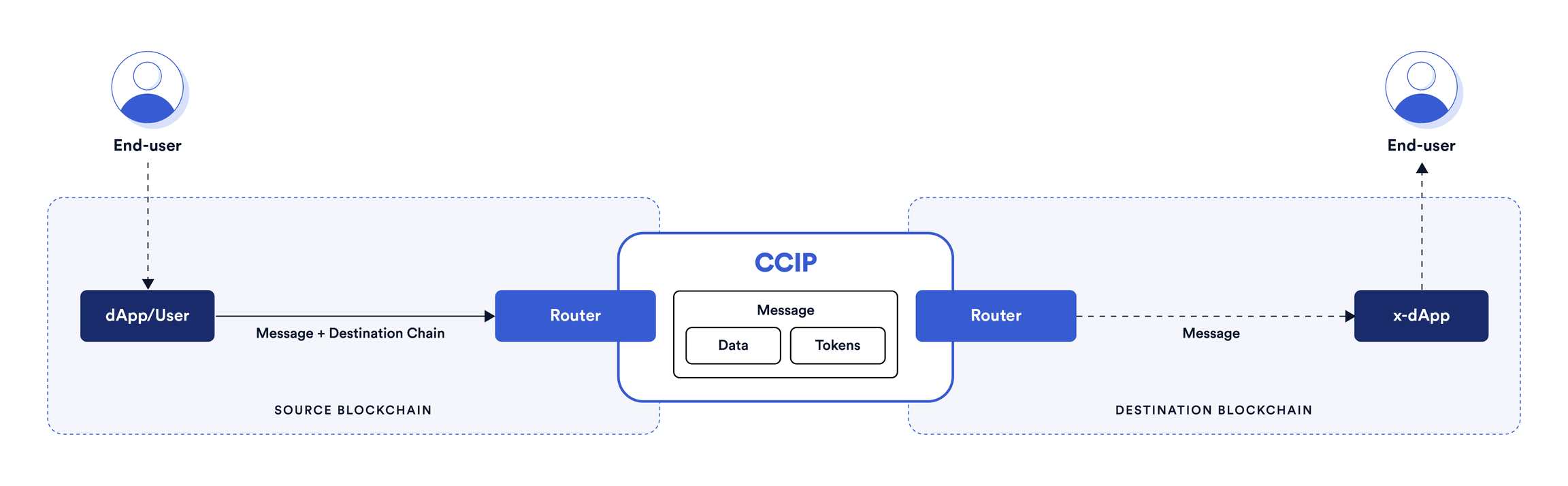
Contents of cross-chain messages Using Chainlink CCIP, we can send the following types of messages across chains:
- Token transfers: Transferring popular tokens that can be native to a chain or wrapped tokens like ETH, LINK, etc. across chains. Here we have a limitation that only supported tokens can be transferred.
- Data transfers: Sending data from one chain to another. This can be used for universal messaging, price feeds, etc.
- Token and data transfers: Both token and data transfers can be combined in a single message.
Along with the message, the sender also needs to provide the chain selector of the destination chain, gas limit and the recipient address. The recipient address can be a smart contract or an EOA. The gas limit is the maximum gas that can be used for the transaction in the destination chain.
Token Transfer Mechanisms
To ensure that the token transfers are secure and the total supply remains the same across chains, Chainlink CCIP uses the following mechanisms:
- Burn and Mint: The tokens are burned on the source chain and minted on the destination chain.
- Lock and Unlock: The tokens are locked on the source chain and unlocked on the destination chain.
- Lock and Mint: The tokens are locked on the source chain and minted on the destination chain.
Chainlink CCIP Risk Management Network
Chainlink CCIP also has a risk management network that ensures the security of cross-chain transactions. The risk management network consists of validators who are responsible for verifying the cross-chain transactions. It works parallel to the primary CCIP system. Some concepts of the risk management network are:
- Blessing: The validators verify the cross-chain transactions and provide a blessing to the transaction. The blessing is a proof that the transaction is valid.
- Cursing: If the validators find any issue with the transaction, they can curse the transaction. The cursed transaction is considered invalid and the tokens are returned to the sender. All CCIP transactions for that chain are paused until the issue is resolved, which requires a manual intervention.
- Finality: Finality is the assurance that past transactions included onchain are extremely difficult or impossible to revert. For CCIP, source chain finality is the main factor that determines the end-to-end elapsed time for CCIP to send a message from one chain to another.
Here we have a more detailed diagram of the CCIP architecture from Chainlink's documentation:
Why Should You Care About Cross-Chain Interoperability?
Unlocking Multi-Chain dApps
The future of blockchain seems to be multi-chain. Developers no longer want to be limited to just one blockchain’s capabilities. Cross-chain interoperability protocols like CCIP make it possible to build dApps that tap into the strengths of several blockchains, creating more robust and flexible applications.
Improved User Experience
For users, cross-chain communication means smoother, more efficient interactions with dApps, whether it's transferring tokens or interacting with smart contracts on different blockchains.
Growth of DeFi and NFTs
As DeFi and NFT projects continue to grow across various blockchains, CCIP and similar protocols open up new possibilities. Cross-chain lending, borrowing, and NFT marketplaces become more feasible when chains can easily exchange data and assets.
Real-World Use Cases for CCIP
- DeFi Protocols: Imagine a scenario where you borrow on Ethereum but use collateral on Avalanche. CCIP can handle such cross-chain transactions.
- NFT Transfers: Move your NFT between Ethereum and another chain, like Solana or Polygon, without needing separate bridges or complicated processes.
- Enterprise Solutions: Businesses could use CCIP to share data between blockchains without having to deal with intermediaries.
Want to Dig Deeper?
For those who want to go beyond the basics, check out Chainlink's CCIP documentation and Chainlink's bootcamp on CCIP. It’s a great way to dive into the technical details and learn how to build cross-chain applications using Chainlink’s protocol.
Final Thoughts
Cross-chain interoperability is shaping the future of blockchain development, and Chainlink’s CCIP is one of the many solutions aiming to make blockchains more connected and accessible. Whether you’re a developer or a user, understanding protocols like CCIP, Polkadot, and Cosmos can help you navigate the increasingly interconnected blockchain world.
Comments
Join the discussionNo comments yet. Be the first to comment.